The Past as Shelter, a Society Without a Future

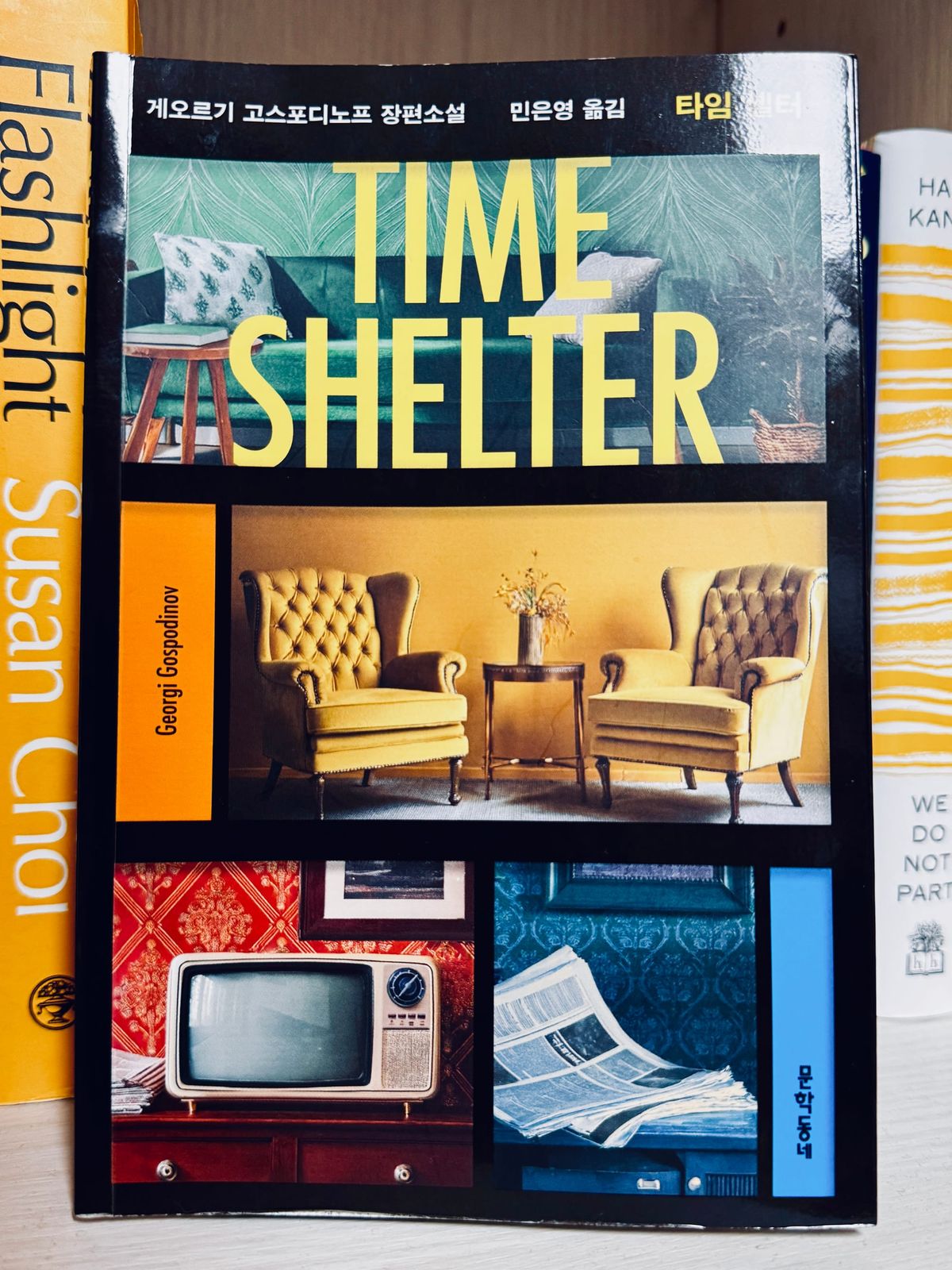
Georgi Gospodinov’s
Time Shelter
and the Politics of Memory in East Asia
When a society can no longer imagine the future, where does it turn?
Georgi Gospodinov’s novel Time Shelter offers a strange and unsettling answer to that question. People do not move forward. They want to go back. And not merely in the sense of remembering the past, but of actually entering and living inside a particular moment in time.
At the center of the novel is a peculiar place called a “clinic of the past.” These clinics recreate specific eras for Alzheimer’s patients: rooms, furniture, music, newspapers, smells, and atmospheres from earlier decades. For those losing their memory, the past becomes a therapeutic space. People who are forgetting who they are find temporary comfort inside the time they can still recognize.
But the novel soon expands this private space of treatment into a political metaphor for society as a whole. Just as individuals lose their memory, societies can lose theirs. Just as individuals seek refuge in the past, nations too begin to idealize a particular moment in history. Eventually, various European countries attempt to decide through national referendums which “best decade” they would like to return to.
Time Shelter, winner of the 2023 International Booker Prize, brought Bulgarian writer Georgi Gospodinov and translator Angela Rodel to the center of world literature. The Booker Prize described the novel as an original and subversive work that explores the temptations of memory and nostalgia on both personal and global levels.
Yet the true power of the novel lies not only in the originality of its premise. Time Shelter shows how “nostalgia,” an emotion we often regard as warm and harmless, can turn into a political danger.
Remembering the past is necessary. Studying history is necessary. The problem begins when the past becomes not an object of memory, but a place of escape. More precisely, it begins when the past is selectively edited, beautified, and turned into a political product. At that point, memory is no longer reflection. It becomes a weapon.
The fact that the novel is set in Europe matters. Europe is a space layered with memories of war, empire, fascism, communism, the Cold War, integration, and fragmentation. In Gospodinov’s imagination, Europeans, unable to endure the anxiety of the present and the uncertainty of the future, set out in search of their own “golden age.” Some countries long for imperial glory, others for postwar prosperity, others for the stability of socialism, and still others for the cultural vitality of youth.
At this point, Time Shelter becomes more than a European novel. It becomes a novel about a political illness shared by almost every society today: the loss of the future.
When the future becomes difficult to trust, society summons the past again.
When the economy feels unstable, people remember a time they believe was more secure.
When identity begins to tremble, the nation imagines a past that was pure and strong.
When politics becomes powerless, leaders begin to speak the language of “going back.”
This is not only Europe’s story. Similar scenes unfold in the United States, Korea, Japan, and China. Only the names of the past each society longs for are different.
In the United States, this can appear in the slogan of making the country “great again.” The question of for whom that past was truly great is often buried, but political language tends to prefer the simple emotion of return over the complexity of reality. In Japan, memories of the postwar peace state, the imperial past, and nostalgia for the era of economic greatness collide with one another. In Korea, memories of compressed economic growth, industrialization, democratization, and the Cold War continue to divide political identities today.
East Asia is a region where the politics of memory operates with particular force. The modern history of this region is entangled with colonial rule, war, division, the Cold War, dictatorship, industrialization, democratization, economic growth, the collapse of empire, and the desire for national revival. Here, the past is not simply a time contained in history textbooks. The past becomes diplomacy, elections, street protests, memorials, textbooks, and cinema.
Historical conflict between Korea and Japan, China’s narrative of the “Century of Humiliation,” Taiwan’s debates over identity, Hong Kong’s memory of democracy, and Korea’s internal clash between memories of industrialization and democratization all touch the questions raised by Time Shelter. How do we remember the past? What do we want to forget? Which era do we beautify and wish to live in again? And whom does that memory serve?
What makes Time Shelter fascinating is that it does not simply condemn nostalgia. The novel understands the human desire to long for the past. Everyone has a time they wish they could return to: a childhood room, an old song, a vanished street, younger parents, a world that seemed simpler. Memory sustains human beings. For the individual, the past is sometimes the last remaining home.
But when a nation begins to long for the past in the same way, the problem becomes far more complicated. Personal nostalgia can be sad and beautiful. National nostalgia, however, can easily become violent. When a nation begins to speak of “lost glory,” hidden inside that language are often the logics of exclusion and hostility. Who was included in that glory, and who was not? Whose pain is remembered, and whose pain is erased?
In East Asia, these questions are even more urgent. Many countries in this region have not yet fully passed through the memories of the twentieth century. The wars have ended, but the memories of war have not. Colonialism has disappeared, but the emotions of colonialism have not. The Cold War has become a term in history books, yet on the Korean Peninsula and across the Taiwan Strait, it remains a living order of the present.
This is why reading Time Shelter from East Asia carries a special meaning. The novel tells us that the past is not merely a legacy to be preserved, but a force that must continually be interpreted and watched with caution. Memory can create a community, but it can also tear one apart. And a society that cannot imagine the future will eventually turn the past into a political shelter.
Littoral East’s way of looking at East Asia can also begin from this question. East Asia is not only a space of economic growth, technology, cities, and consumer culture. It is a coastal civilization where memory is constantly being rearranged. Seoul, Tokyo, Taipei, Hong Kong, and Shanghai may all appear to be futuristic cities, but beneath their surfaces flow memories of colonialism, war, migration, development, censorship, resistance, and loss.
The cities we inhabit seem to be racing toward the future, but in truth, they exist by negotiating with the past every day. Redeveloped neighborhoods, disappearing alleys, restored palaces, rewritten textbooks, commemorated events, and silenced events. The surface of the city may look modern, but the time inside it is never linear. The East Asian city is always a place where several eras overlap.
Time Shelter reveals both the danger and the beauty of such layered time. The past does not disappear. It returns as furniture in a room, as the melody of a song, as a national slogan, as the language of an election, and as silence within a family. The question is how we choose to receive that past.
The past can be a shelter.
But if we stay there too long, we lose the present.
And a society that loses the present cannot build the future.
This is the most important warning left by Time Shelter.
Memory is necessary, but we cannot live inside memory.
History must be learned, but we must not be trapped inside the rooms of history.
What a society truly needs in order to mature is not the ability to return to the past, but the ability to face the past and still imagine the future again.
Time Shelter is a novel that came from Europe, but its questions have already arrived on the shores of East Asia.