The Quiet Intelligence of Japanese Fountain Pens

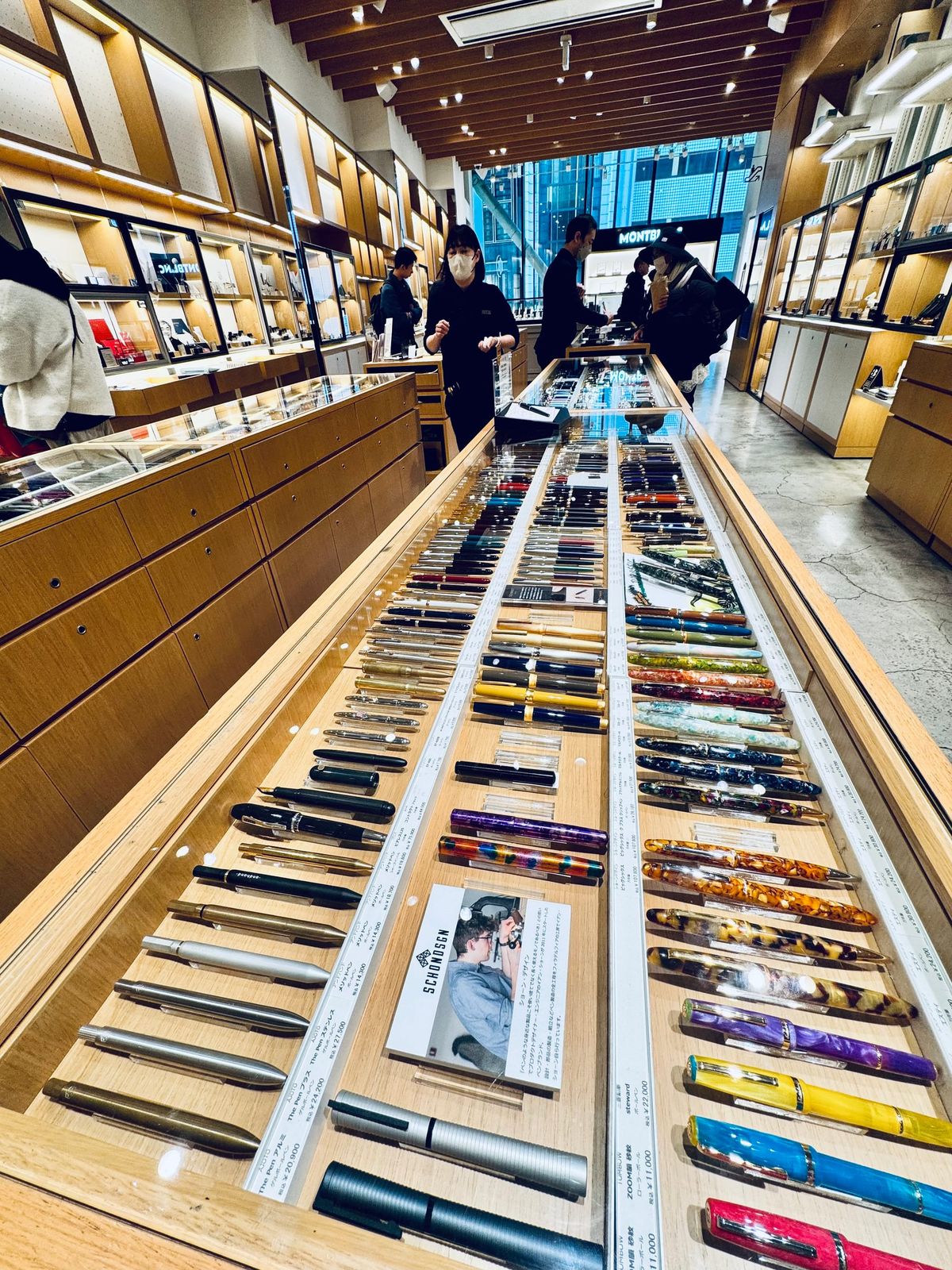
On writing instruments and slow time, from a fountain pen counter at Ginza Itoya
Standing in front of the fountain pen counter at Ginza Itoya, one feels as if time has slowed down a little.
Under the glass, dozens of pens are arranged in neat rows. Black, silver, gold, deep green, marble-like patterns, transparent bodies, brown barrels that resemble old tobacco pipes. The wooden display and warm lighting make these small tools look almost like objects in an exhibition. They do not seem like mere products waiting to be sold. Rather, they look like small objects holding sentences that have not yet been written.
To some, a fountain pen may seem like an expensive and outdated piece of stationery. We already write, delete, copy, and send things quickly enough with laptops and smartphones. Writing by hand has become an increasingly slow and inconvenient act. And yet there is a reason we linger in front of a fountain pen display. A fountain pen is not simply a tool for writing letters. It is an object that asks something of the person who uses it.
I like fountain pens. I like collecting them, and I like actually writing with them. When I hold a fountain pen in my hand, a different kind of time begins. The scratch of the nib as it moves across paper, the moment when ink sinks in and spreads ever so slightly, the subtle changes in line width depending on the pressure and angle of the hand — these are sensations that a keyboard cannot offer.
Sentences written on a keyboard are fast. The fingers move ahead of thought, and a mistaken sentence disappears instantly. Words on a screen can be revised at any moment, and for that reason they sometimes feel too light. By contrast, sentences written with a fountain pen feel a little heavier. Ink remains on the paper, the hand must control its speed, and thought follows the rhythm of handwriting. A fountain pen turns writing from an efficient act of input into an act that passes through the body.
In that sense, a fountain pen is a strange object. By modern standards, it is certainly inefficient. You have to fill it with ink, choose the right paper, and wait for the ink to dry. The nib is delicate, the ink can bleed, and if you are unlucky, it may leak inside your bag. Compared with a ballpoint pen or a smartphone memo app, it comes with many inconveniences.
And yet, precisely because of that inconvenience, the fountain pen becomes a tool for thought.
Not every good tool needs to make us faster. Some tools make us slower. A fountain pen is one of them. It tells the person writing to pause for a moment. It asks you to choose paper, open the cap, tilt the nib, and wait until the first stroke appears. It holds back the sentence from flowing too quickly.
This is also what makes Japanese stationery culture so fascinating. Japanese stationery often persuades not through flamboyance, but through attentiveness. It is a culture that refines small and seemingly minor differences to the end. The feeling of an object in the hand, the sound it makes against paper, the speed of ink flow, the sensation of a cap closing — all of these become part of the product. Good Japanese stationery does not shout, “Look at me.” It quietly reveals its value in the user’s hand.
A place like Ginza Itoya heightens that sensibility. There, stationery is not simply displayed as consumer goods. Pens, paper, ink, notebooks, cards, envelopes, and bookmarks are arranged almost as a way of life. The acts of writing, recording, giving, preserving, and rereading are all connected. A stationery store becomes more than a shop. It becomes a small cultural space where paper, the hand, and time meet.
Japan’s fountain pen culture fits naturally with this attentiveness. Brands such as Pilot, Sailor, and Platinum have not made fountain pens merely as objects of luxury hobbyism. They have finely tuned the very sensation of writing. The flexibility of the nib, the flow of ink, the weight of the barrel, the balance in the hand — these are things that cannot be understood by sight alone. A fountain pen is, in the end, an object that must be written with in order to be known.
This is important. A fountain pen is closer to an experience than to an image. A pen that looks beautiful in a photograph may not suit the hand in practice, while a pen that looks ordinary may feel surprisingly natural on paper. A good fountain pen does not make the hand show off. Rather, it helps the hand follow thought.
Choosing a fountain pen, then, is not merely a matter of taste. It is also a question of what speed you want to write at, what weight of sentence you prefer, and what kind of tactile sensation allows your thoughts to flow. Some people like a fine line. Others prefer a broad nib that lets the ink flow generously. Some like the neatness of black ink, while others are drawn to the subtle atmosphere created by blue or brown ink. A fountain pen is ultimately a tool for handwriting, but also a tool of temperament.
In the digital age, we are too often surrounded by smooth things. Screens are clean, letters are uniform, and revision is immediate. In that world, traces do not remain easily. But a fountain pen leaves traces. Ink seeps into the fibers of paper, handwriting reveals the condition of the hand, and a mistaken word never disappears completely. That imperfection feels, somehow, more human.
To write by hand is to make thought a little less convenient. And that inconvenience is sometimes necessary. Thoughts that move too quickly are easily consumed; sentences that arrive too quickly are easily forgotten. A sentence written with a fountain pen appears slowly, and because of that, the person writing must look a little longer at what they are trying to say.
For this reason, I do not think of the fountain pen as a simple retro preference. A fountain pen is not merely an object of the past. It may be a small form of resistance to the speed of the present. In an age of writing quickly, deleting quickly, and forgetting quickly, writing in ink is closer to an attitude of thinking more slowly.
Of course, I do not mean that everyone should use a fountain pen. Using one does not automatically make writing deeper, and an expensive pen does not guarantee a good sentence. But some objects change our lives in very subtle ways. A fountain pen is one of them. It reveals its meaning not when it rests on a desk, but when it is held in the hand and the first stroke appears on paper.
Objects are not merely things to be consumed. Some objects contain the aesthetic sense, technology, philosophy of living, and sense of time of a culture. In a single fountain pen, there is manufacturing precision, respect for the act of writing, sensitivity to paper, and an attachment to slow time.
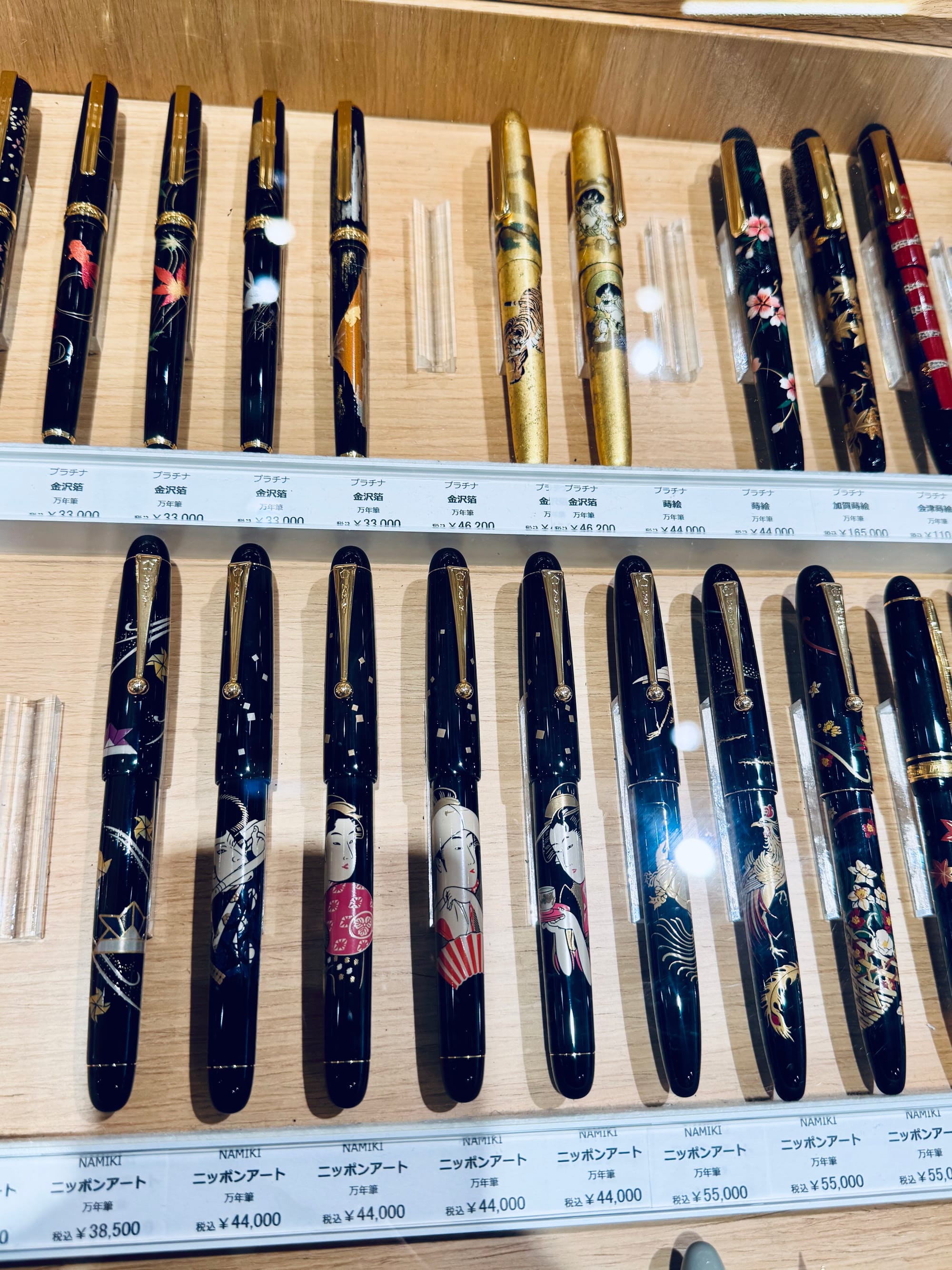
What I saw in front of the fountain pen counter at Ginza Itoya was not simply a large number of pens. It was an entire world surrounding the act of writing. The pens beneath the glass were products with different prices, brands, and colors. But at the same time, they seemed to be asking the same questions.
At what speed do you want to think?
With what feeling of the hand do you want to leave your sentences behind?
How quickly should your time flow?
Good objects sometimes make life more convenient.
But some objects make life a little slower.
The fountain pen belongs to the latter.
And in that slowness, we rediscover the long-forgotten sensation of writing.