Seoul, a City That Never Stops Revising Itself

On redevelopment, memory, capital, and the rapidly changing face of a city
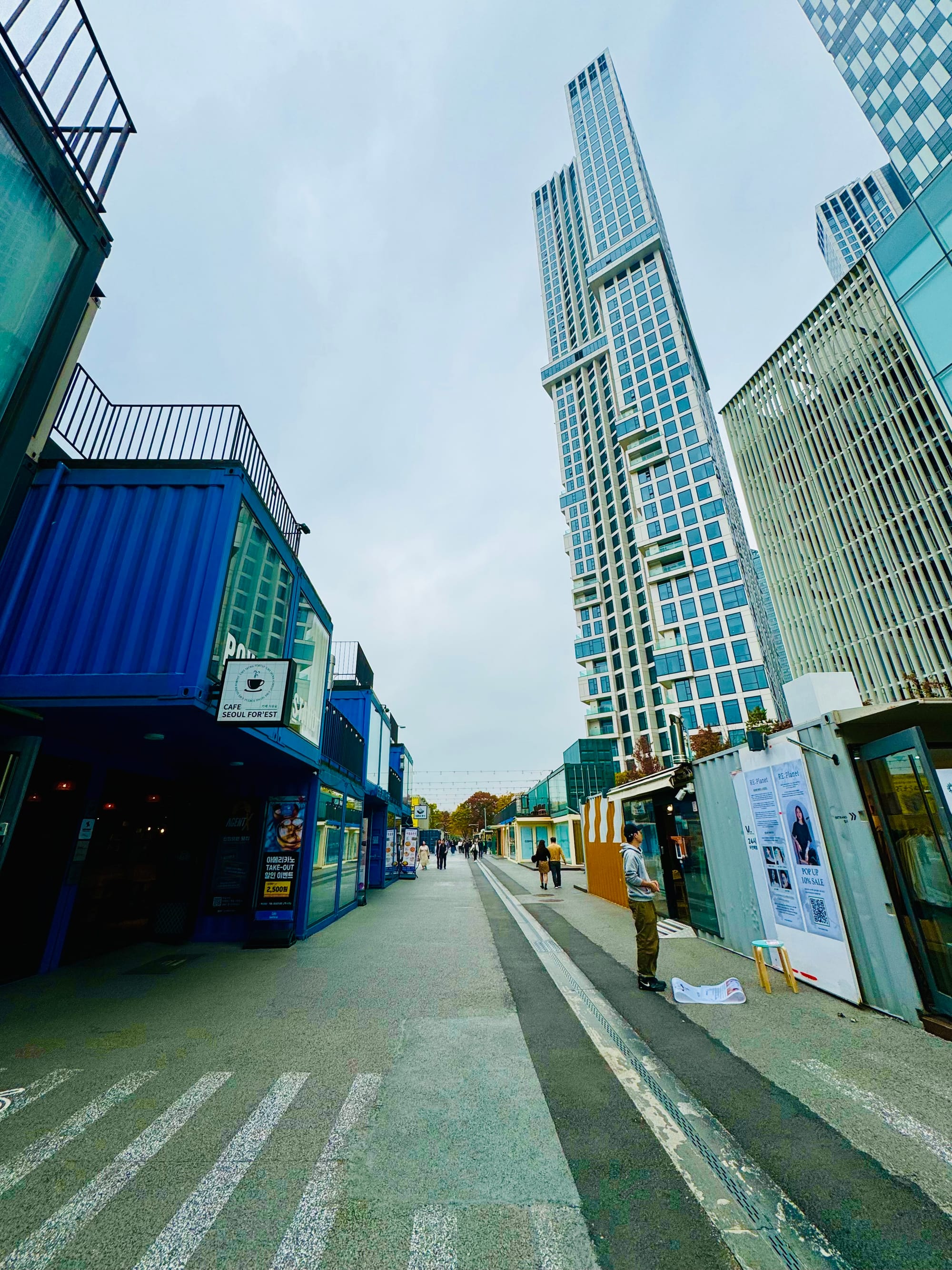
Seoul is a city that never stays still.
Cities change by nature. Buildings age, people leave, new roads appear, and old shops close their doors. But Seoul’s transformation often feels less like a natural process of change and more like an almost compulsive speed of revision. This city is constantly rewriting itself, erasing itself, and building itself again. Yesterday’s alley becomes today’s construction site. Today’s apartment becomes tomorrow’s redevelopment target.
Anyone who has lived in Seoul for a long time knows this feeling. The feeling of returning to a neighborhood after only a few years and losing your sense of direction. The feeling of seeing a shop that existed in your memory disappear, replaced by a glass-fronted building or a franchise café. The feeling of realizing that the air, signs, smells, and sounds of an alley you once knew have changed all at once.
I have often felt this difference when visiting cities in the United States and Japan. Of course, New York, Los Angeles, Tokyo, and Kyoto all change. No city keeps time completely still. But when I think back to American and Japanese cities I visited twenty years ago or ten years ago, their changes often felt more gradual, more accumulated over time. Old buildings remained. The texture of old streets was preserved. The face of the city often seemed to hold its shape.
Seoul is different. In Seoul, change is visible. Within only a few years, the skyline shifts, the economic atmosphere of a neighborhood changes, and old residential districts turn into new apartment complexes. This city does not simply grow older little by little. It seems to update itself constantly into a new version.
This speed of change resembles the compressed nature of modern Korean history. Seoul is a city that began from the ruins after war, then passed through industrialization and democratization, the Olympics and globalization, the IMF financial crisis and the rise of real estate, the digital economy and the growth of K-culture, all within a short span of time. Seoul has passed through too many eras in a single century. As a result, the city’s spaces do not seem to contain the past in calm layers. Instead, the traces of different periods appear to overlap while pushing against one another.
At the center of this process are always redevelopment and reconstruction.
In Seoul, redevelopment and reconstruction are not merely matters of urban planning. They are conditions of life, questions of class, questions of assets, and matters in which expectations and anxieties about the future are deeply entangled. The stated purpose of improving old residential environments and creating a safer, more convenient city certainly has legitimacy. Aging buildings, insufficient parking, poor infrastructure, and safety concerns are directly connected to the lives of citizens.
But the process is never simple.
For some, redevelopment is a long-awaited opportunity. An old home becomes a new apartment. Asset values rise. A more convenient living environment appears. For some, it is a crucial asset strategy, a hope for old age, and what may feel like one of the few remaining paths to upward mobility. In Seoul, real estate is not merely a place to live. It is one of the most powerful assets symbolizing stability and future possibility in a capitalist society.
For others, however, redevelopment is loss. It means leaving a neighborhood where they have lived for a long time. It means losing familiar neighbors, shops, and the rhythms of everyday life. It means being pushed out of a city to which they cannot return with the compensation they receive. Tenants, small merchants, the elderly, and old shops in narrow alleys are easily erased by the language of development. Behind the phrase “improving old spaces,” there is often the reality that someone’s entire life must be moved elsewhere.
This is why redevelopment in Seoul always produces both expectation and conflict. Even within the same neighborhood, some people want the project to proceed quickly, while others want to remain longer. Some anticipate rising housing prices, while others worry about rising rents. Some see old alleys as inefficient spaces, while others see memories of life that could exist only there.
The interests involved are complex. Owners and tenants, association members and non-members, merchants and residents, developers and administrative agencies, investors and original residents, younger generations and older generations all see the same space from different positions. Everyone wants a better life, but the meaning of “a better city” changes depending on where one stands.
The capitalism of Seoul becomes most visible at precisely this point. This city does not hide desire. A better home, a higher price, more convenient transportation, a more refined commercial district, a better school zone, a higher-brand apartment. Space in Seoul is both a place of life and an object of investment. A home is a place to stay, but also an asset expected to rise. A neighborhood is a community, but also a commodity evaluated by the market.
This is what makes Seoul both fascinating and exhausting.
In Seoul, there is always a “next.” The next station area, the next redevelopment district, the next hot place, the next branded apartment complex, the next commercial district. The present of the city does not simply remain enough in itself. It is constantly converted into future value. The building that stands now is read as something that may soon be demolished. The alley that exists now is interpreted as something that may soon be developed. Seoul is a city that lives in the present while always imagining its next version.
But when a city keeps rewriting itself, what remains?
This is a question one cannot avoid when thinking about Seoul. Change is necessary. We cannot simply say that old spaces must always be preserved. Urban infrastructure needs improvement, residential conditions must get better, and spaces for new generations must be created. The issue is not change itself, but the speed and method of change. What will be remembered, and what will be erased? For whom is the city being changed, and who is being pushed out? Should the value of a place be judged only by price, or should we also consider the time and relationships accumulated within it?
Seoul has often chosen to write something new over the past rather than preserve the past itself. In this city, memory is often weaker than buildings, landscape weaker than development plans, and the feeling of place less powerful than the language of real estate. But this does not mean Seoul has no memory. On the contrary, because the city changes too quickly, memory becomes even more urgent.
Vanished theaters, disappeared markets, redeveloped alleys, demolished houses, renamed neighborhoods, apartment complexes no longer inhabited by the same people. Seoul’s memories often remain less in surviving buildings than in people’s words, photographs, old signs, maps, literature, films, and private walks. To read this city may be to read the traces of such disappearances.
Seoul is beautiful. But its beauty does not come from the harmony of a finished city. Rather, Seoul’s beauty comes from instability, speed, contradiction, ambition, wounds, and resilience. This city changes too quickly, demolishes too much, and rebuilds itself too often. Yet in that very process, Seoul becomes the most compressed face of modern Korean history.
Seoul is not a city where tradition and modernity peacefully coexist. It is a city where tradition and modernity constantly collide and negotiate. Buildings rise beside palaces. Luxury residential towers appear near old markets. Advertisements for branded apartment complexes hang beyond the worn walls of redevelopment districts. The past and the future push against one another on the same road, while also needing one another.
That is why Seoul is a city worth reading.
This city is too complex to be consumed simply as a tourist destination, and it carries too many wounds to be praised merely as a successful global city. Seoul is a city of growth and anxiety, desire and memory. For some, it is a city of opportunity. For others, it is a city from which they are continuously pushed away. All of this makes up the face of Seoul.
To read Seoul is to look at precisely this complexity. It means reading its cafés and bookstores, palaces and apartments, redevelopment districts and old markets, subway stations and museums, the Han River and its alleys together. It means looking not only at the surface of rapid change, but also at the expectations and conflicts, capital and memory, loss and possibility entangled beneath it.
Seoul is a city that never stops revising itself.
That sentence is both praise and question.
Some sentences are revised in order to become better.
Some sentences are revised so many times that they lose their original feeling.
And some sentences, only after being erased, make us realize that we had remembered them all along.